Venice has no cars, no buses, no bicycles. When you need to get somewhere that your feet can't take you, you get on a boat. This sounds romantic until you're standing at a vaporetto stop in the rain, watching the wrong line pull away, with no clear idea when the next one's coming or whether it'll stop at the place you need.
The water transport system in Venice is excellent once you understand it. The problem is that nobody explains it to you beforehand, so your first day involves a lot of squinting at route maps bolted to floating pontoons while other passengers push past you with the confidence of people who've been doing this their whole lives. Which they have.
Here's everything I've learned about getting around Venice by water over the past seventeen years.
In This Article
The Vaporetto: Venice's Floating Bus
A vaporetto is, essentially, a bus that floats. They're operated by ACTV (the same company that runs buses on the mainland) and they follow fixed routes with fixed stops, just like public transport anywhere. Except the routes are canals, the stops are floating pontoons, and the whole thing is slightly more dramatic than a bus.
The boats are large — capable of holding 200+ passengers — and they run frequently, especially on the main routes. During summer daytime hours, you'll rarely wait more than 7–10 minutes for a boat on the Grand Canal. In winter, frequencies drop, and some routes run only every 20 minutes.
Each stop has electronic boards showing the next arrivals, though I wouldn't stake my life on their accuracy. They're usually right. Usually.
Which Lines Actually Matter
ACTV runs about 25 different water bus routes, but as a visitor you'll use maybe four of them. Here are the ones worth knowing:
- Line 1 — The all-stops route down the Grand Canal. Piazzale Roma → Ferrovia (train station) → every stop along the Grand Canal → San Marco → Lido. Takes about 45 minutes end to end. This is the one I tell everyone to ride at least once. Grab a seat at the back, outside, and watch the palazzi slide past. It's the best €9.50 sightseeing tour in any European city.
- Line 2 — The express version of the same route. Fewer stops, roughly 25 minutes from Piazzale Roma to San Marco. Take this when you actually need to get somewhere rather than sightsee. Also goes to Giudecca and Tronchetto.
- Lines 4.1 and 4.2 — Circular routes around the outside of the city. 4.1 goes clockwise, 4.2 counter-clockwise. These connect Murano to Fondamente Nove and the main island. Useful if you're heading to Murano or just want a different perspective of the city from the northern lagoon.
- Lines 5.1 and 5.2 — Another circular pair, but these ones run via the Giudecca Canal to the south and connect to the Lido. Useful for reaching Giudecca or the Lido from various points.
- Line 12 — The island-hopper. Fondamente Nove → Murano → Mazzorbo → Burano → Torcello. This is the route for the day trip to Burano (the coloured houses) and Torcello (the ancient cathedral). Allow 45 minutes to Burano, about an hour to Torcello. Runs roughly every 30 minutes.
Tickets, Passes, and the Maths
Here's where it gets interesting. A single vaporetto ride costs €9.50. That's any distance, any direction — one stop or twenty stops, same price. It's valid for 75 minutes from validation, during which you can change boats (but only in the same general direction; you can't ride out and back on one ticket).
For residents, the cost is €1.50. For tourists, it's €9.50. That's the system. Complaining about it won't change it, so let's move on to the passes:
| Pass Type | Price | Break-Even |
|---|---|---|
| Single ride | €9.50 | — |
| 24-hour pass | €25 | 3 rides |
| 48-hour pass | €35 | 4 rides over 2 days |
| 72-hour pass | €45 | 5 rides over 3 days |
| 7-day pass | €65 | 7 rides over a week |
The 7-day pass is remarkable value if you're staying a week. It works out to €9.30 per day — less than a single ride. You can hop on and off vaporetti like buses, ride out to Murano for lunch, come back, ride to the Lido for an afternoon swim, come back again. It changes how you use the city.
Where to buy: ACTV ticket offices at Piazzale Roma, Ferrovia (train station), and larger vaporetto stops. Tabacchi shops throughout the city. The Venezia Unica website (buy in advance, collect at a machine). The AVM Venezia app on your phone — this is the easiest method. Buy the ticket on the app, activate it when you board, and it generates a QR code for the validator.
Validation is not optional. You must tap your ticket or hold your phone to the white validator on the dock before boarding. Inspectors do check. The fine for riding without a validated ticket is €60 on top of the fare. I've seen tourists argue that they "didn't know" — the inspectors are unmoved. They've heard it before.
The validator beeps and flashes green when it works. If it flashes red or does nothing, try again. If it still doesn't work, find an ACTV official on the dock. Do not just get on the boat and hope for the best. I tried that once. The inspector was not interested in my story about the broken machine.
Traghetto: The €2 Gondola Ride Nobody Tells You About
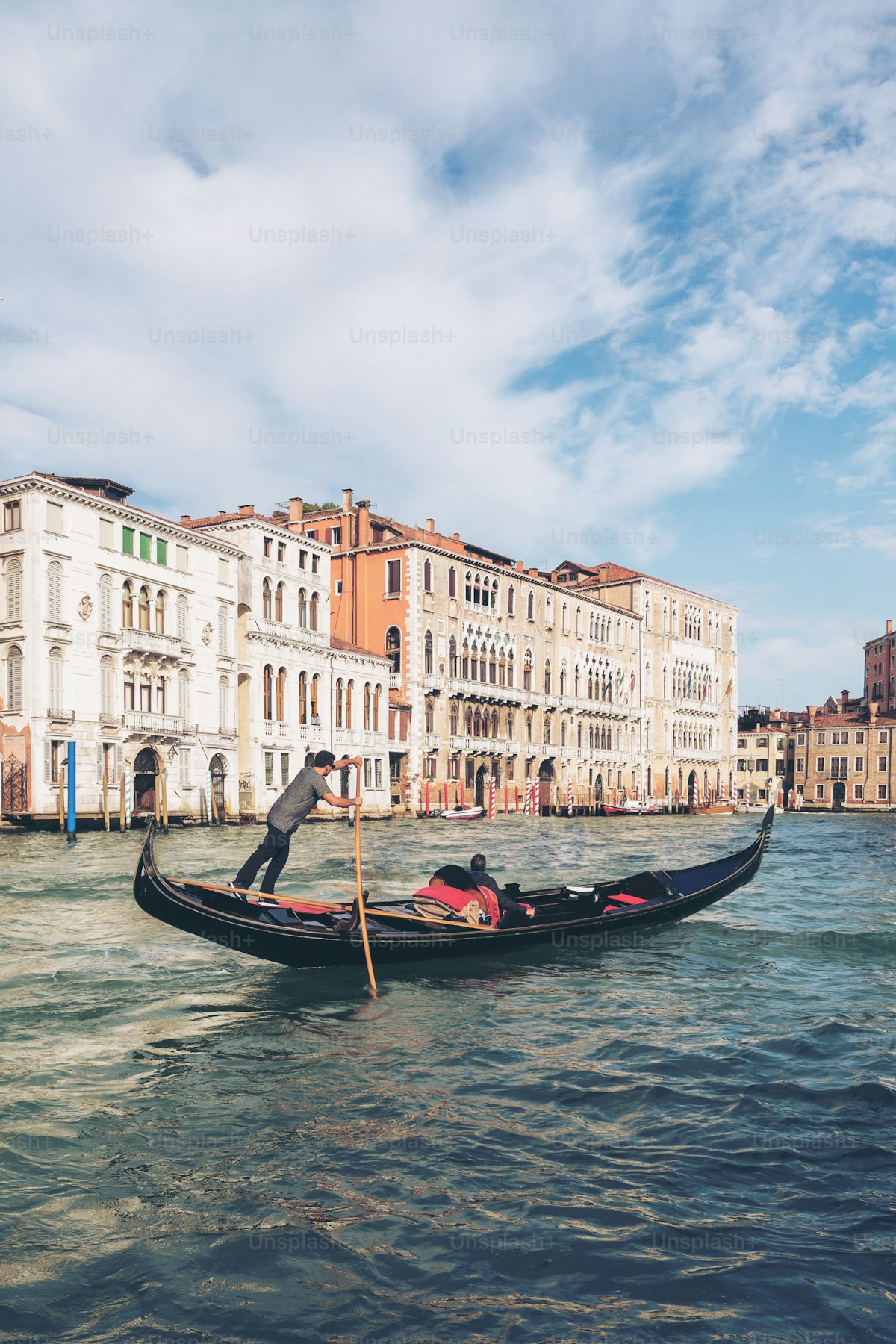
The Grand Canal has only four bridges along its entire 3.8 km length: at the station, Rialto, Accademia, and the modern Calatrava bridge near Piazzale Roma. That leaves large stretches where, if you want to cross, you either walk fifteen minutes to a bridge or take a traghetto.
A traghetto is a stripped-down gondola — same boat, no cushions, no singing — that ferries passengers across the Grand Canal at specific points. The crossing takes about two minutes. The cost is €2 (paid in cash to the gondolier as you step on). There are currently about five or six operating routes, though the number fluctuates and some only run in the mornings.
The etiquette: locals stand. Tourists sit. Nobody will judge you for sitting, but if you want to stand, brace your feet about shoulder-width apart, keep your centre of gravity low, and don't grab the person next to you when the boat rocks. I stood on my third try. I sat on my first two after nearly going into the Grand Canal, which would have been both cold and embarrassing.
Traghetto routes aren't marked on most tourist maps and Google Maps doesn't show them. Look for small "TRAGHETTO" signs on yellow arrows near the Grand Canal. The most reliable crossings are near San Tomà, Santa Sofia (near the fish market), and San Samuele.
Water Taxis: When Luxury Makes Sense
Water taxis are the private cars of Venice. Beautiful mahogany motorboats, polished brass fittings, leather seats, and a driver who knows every canal in the city. They're also shockingly expensive.
A water taxi from the train station to a hotel near San Marco will cost around €70–80. From the airport, it's €110–130. There are surcharges for night service, extra luggage, extra passengers beyond four, and — during particularly busy periods — the simple fact that they can charge more because you're standing on a dock with suitcases and no other option.
When do they make sense? Three situations:
- Groups of 3–4 people. Split four ways, an €80 ride is €20 each — not much more than a vaporetto single, and you get door-to-door service.
- Late at night with luggage. Vaporetto service drops to one line (the N) after midnight. If your hotel is in Castello and you're arriving at 1am with two suitcases, the water taxi is the only reasonable option. Walking Venice's cobblestones with rolling luggage at night is an exercise in frustration and noise.
- Special occasions. Arriving for an anniversary or proposal? Pulling up to your hotel's water entrance in a gleaming taxi acqueo at sunset is an experience that photographs don't fully capture. It's theatrical. Venice approves of theatre.
Book through Consorzio Motoscafi Venezia or through your hotel. Booking ahead usually doesn't save money, but it saves the 15–20 minutes of waiting at a taxi stand for the next available boat.
Getting Around After Midnight
Regular vaporetto service ends around 11:30pm on most lines. After that, the N line (notturno) takes over. It runs a single route that covers the Grand Canal and the main stops, approximately every 20 minutes through the night.
The N line is functional but slow. If you're staying far from the Grand Canal — in Castello, for instance — the walk from the nearest N line stop to your hotel can be longer than the boat ride itself. In winter, this walk is cold and dark, through narrow streets that all look identical at 2am. I got lost walking home from the N line in Dorsoduro in 2017 and ended up at the same dead-end canal three times before finding the right turning.
Water taxis operate 24 hours. If you're stranded far from your hotel after midnight and the N line isn't helping, they're your fallback — but expect to pay the night surcharge.
Mistakes Tourists Make on Venice's Boats
I've made most of these personally, so this isn't judgment — it's solidarity.
- Not validating the ticket. I've covered this above, but it bears repeating. Validate before boarding. Every time. Even with a pass.
- Getting on the wrong direction. Many vaporetto stops have two separate pontoons — one for each direction. They're sometimes on opposite sides of a canal or around a corner from each other. Check the direction board before you queue. At San Zaccaria, for instance, there are four separate pontoon areas for different lines and directions. It's confusing. Take a moment to read the signs.
- Standing in the wrong place. The front outdoor deck has the best views. It's also where everyone wants to stand, so it fills first. The back deck is nearly as good. The indoor section is useful in rain or winter but offers limited views. If you're riding Line 1 down the Grand Canal for the scenery, arrive early and claim a spot outside.
- Buying single tickets instead of a pass. I did this for my first three visits before I sat down and did the arithmetic. If you're riding more than twice in a day, the day pass saves money. If you're staying more than two days and plan to ride regularly, do the maths before you buy.
- Trying to ride without a ticket at all. The fine is €60. Inspectors board without warning, usually mid-route when you can't escape. I've watched people try to bluff, claim language barriers, or pretend they just got on and were "about to buy." None of it works.
- Ignoring the traghetto. Most tourists walk right past the traghetto signs without noticing them, then walk fifteen minutes to the Rialto Bridge to cross the Grand Canal when a two-minute, €2 crossing was available fifty metres from where they were standing. Use the traghetti.
Venice's water transport system isn't complicated once you've used it a few times. The routes are logical, the boats are reliable, and the whole experience of commuting by water — watching the light change on the facades as you chug down the Grand Canal, the controlled chaos of boarding at San Marco, the wind on the open lagoon crossing to Burano — is one of the things that makes Venice unlike any other city.
It took me about three visits to stop feeling confused by it. By the fifth, I was reading the route maps without thinking. By the tenth, I was standing on the traghetto without holding on. Progress comes slowly in Venice, which is, if you think about it, the whole point.